
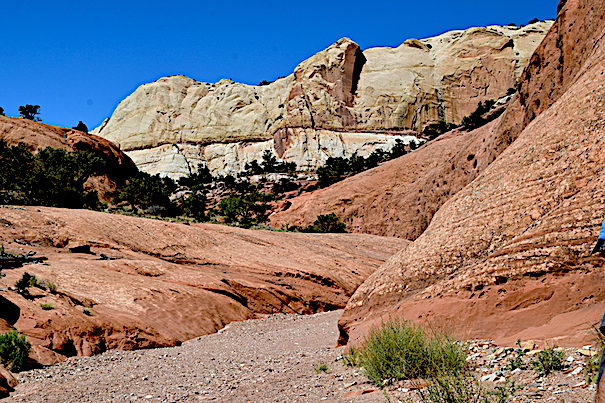
Formerly in the Grand Staircase-Escalante NM, Utah (Mike Painter)
September 8, 2026
Dear CalUWild Friends & Supporters—
Though there are still two weeks to go until the Fall Equinox, Summer is pretty much over, with school back in session. Now can be a great time to get out and visit many of our public lands, though they are more heavily visited in the “shoulder season” now than in times past. And this year is seeing severe flash flooding and wildfire, too, so be aware!
September 3 was the anniversary of the signing of the Wilderness Act in 1964, and September 18 is the 30th Anniversary of the designation of Grand Staircase-Escalante National Monument. Both dates are of great significance to CalUWild, since we started out in 1997 with the development of the management plan for the Monument..
Congress was recessed for much of August, so there was not a lot of activity on Capitol Hill. That doesn’t mean, though, that nothing happened in Washington, which makes for a somewhat long Update this month. The administration spent the month working to dismantle more regulations. See ITEM 3 regarding the Forest Service Roadless Rule. And the Army Corps of Engineers just announced last Friday that it plans to roll back protections for wetlands. See this article in the New York Times. (gift link for non-subscribers, though the Times seems to now require you to set up a free user account in order to read it)
Also very concerning is that last Friday also, GOP members of the Subcommittee on Oversight and Investigations of the House Natural Resources Committee announced an investigation into nineteen “extremist environmental organizations.” They are:
Alliance for the Wild Rockies, Cascadia Wildlands, Center for Biological Diversity, Defenders of Wildlife, Earthjustice, Great Old Broads for Wilderness, High Country Conservation Advocates, Montana Environmental Information Center, Native Ecosystems Council, Natural Resources Defense Council, Oregon Wild, Rocky Mountain Wild, San Juan Citizens Alliance, Sierra Club, Western Watersheds Project, WildEarth Guardians, The Wilderness Society, Wilderness Watch, and Wilderness Workshop
Many of these are organizations that CalUWild works closely with (though not in litigation). The subcommittee is concerned with the organizations’ supposed “coordinated capitalization on misleading and emotive messaging to build powerful and profitable litigation machines funded by taxpayer dollars through the exploitation of statutory fee-shifting provisions.” (Some environmental laws allow plaintiffs’ litigation costs to be reimbursed by the government.) We’ll be following this topic closely.
Many thanks to all of you who have worked so hard to protect our Wilderness areas and other public lands. The fight goes on!
Best wishes,
Mike Painter, Coordinator
IN UTAH
1. Rollbacks of Grand Staircase-Escalante &
Bears Ears National Monuments
(ACTION ITEM)
IN CALIFORNIA
2. Yosemite Land Exchange Proposal
(ACTION ITEM)
IN GENERAL
3. The Administration Proposes to Eliminate
The Forest Service Roadless Rule
COMMENTS NEEDED
DEADLINE: September 21
(ACTION ITEM)
4. National Public Lands Day
September 26
(ACTION ITEM)
IN THE PRESS & ELSEWHERE
5. Links to Articles and Other Items of Interest
=-=-=-=-=-=-=-=-=-=-=-=-=-=-=-=-=-=-=-=-=-=-=-=-=-=-=-=-=-=-=-=-=
IN UTAH
1. Rollbacks of Grand Staircase-Escalante &
Bears Ears National Monuments
(ACTION ITEM)
As we reported in our last Update , the president signed proclamations shrinking both Grand Staircase-Escalante and Bears Ears national monuments by a whopping 90% each. Reaction nationwide has been mostly opposed to the action, though some ant-public lands folks have applauded it.
This week, the plaintiffs in the lawsuit from 2017, opposing the original White House shrinking, filed papers requesting the court to re-activate the case, which had been paused during the Biden Administration.
If you haven’t already, please call your member of Congress and two senators to object to the administration’s actions. And remind them that this is why America’s Red Rock Wilderness Act (H.R.2467 / S.1193) is so important—it provides permanent protection for the wildest undeveloped BLM land in the state. If they’re a cosponsor of the bill, thank them for that, or if not, ask them to become one. CalUWild’s website contains a full listing of California Senate and House cosponsorships and Washington, DC office phone numbers.
The Monuments for All Coalition still has its online form letter open (though use your own words to the extent possible). It will deliver your letter to the White House, your senators, and your representative. You do need to include personal information for them to be delivered, but you can opt out from receiving further information from them.
U.S. Senators Ben Ray Luján (D-NM), Martin Heinrich (D-NM), and Dick Durbin (D-IL) circulated a letter signed by 34 other senators (no Republicans, unfortunately) to the president objecting to the rollbacks of the monuments. You can read the press release and text of the letter here.
We recently got word that Utah Sen. Mike Lee (R) received an opinion from the Government Accountability Office that the Bears Ears National Monument Management Plan is a “rule,” falling under the purview of the Congressional Review Act. He has not introduced a resolution of disapproval yet, but this potentially sets up a controversy in Congress identical to the ones we fought over the Grand Staircase-Escalante NM (which failed due to lack of a vote in the Senate) and the mineral withdrawal in Minnesota, upstream from the Boundary Waters Canoe Area Wilderness. We’ll keep you posted.
The New York Times published an (unsurprising) article: Documents Undercut Trump’s Claims About Utah National Monument (gift link for non-subscribers, with free user account).
Our friends at the Center for Western Priorities published a response to an interview with the Interior Secretary last month: National monuments fact check: How many lies can Doug Burgum tell in 60 seconds?. It’s incredible that Mr. Burgum could be so totally misinformed about facts that anyone could verify in no time at all.
IN CALIFORNIA
2. Yosemite Land Exchange Proposal
(ACTION ITEM)
Outrage erupted across the country last week when it was widely reported that the administration is considering exchanging a parcel of land on the western edge of Yosemite National Park with a developer (a contributor to the president’s election campaigns), so he could more easily access his property—through the Park. Were he go ahead with plans to develop an upscale resort on the property, his guests would then have easy, private access to the Park, as well.
Previous owners of the parcel have made repeated overtures to the Park Service to gain access, and several past administrations turned them down. A court in California also previously ruled against the proposal.
The Interior Department had notified Congress that it was considering the exchange and that it might use funds from the Land & Water Conservation Fund (LWCF) to cover associated expenses. However, should an exchange take place at all, it ought to be the developer paying any expenses, not the government. Additionally, the LWCF is for funding purchases of land and to enhance public recreation opportunities. This proposal would do neither.
Though no deal has been formalized, it should be clear to all that this is not acceptable. Our national parks are not for sale, and no private parties should have preferential access to them, either.
Please call your representatives in Congress, both House and Senate, voicing your opposition to the Interior Department’s proposal. Their contact information can be found online on our California Congressional Information Sheet. Please also send a comment to the Interior Department via the contact form on its website.
You can read the original reporting from The Washington Sun (News Of The United States) here: Trump’s Quietly Working to Give Part of Yosemite to a Private Developer
California Assemblymember Greg Wallis (R-47) sent a letter, signed by 63 members of the California State legislature from both parties, to Secty, Burgum opposing any transfer. If your Assemblymember or Senator is on the list of signers, please call their office to say thanks. Click here to find your Legislative representatives.
Robert Binnewies, former Superintendent of Yosemite, wrote an op-ed in the San Francisco Chronicle: Doug Burgum’s Yosemite development deal reeks of corruption (gift link for non-subscribers)
In national park-related news, the Coalition to Protect America’s National Parks sent a letter to Interior Secretary Doug Burgum: Former National Park Superintendents Warn Interior Secretary: National Parks Are in Crisis. The Coalition consists of over 5,200 members and supporters, including current, former, and retired employees and volunteers of the National Park Service.
And The Washington Sun had this further reporting today: Trump Is Quietly Planning to Majorly Change How National Parks Are Run
IN GENERAL
3. The Administration Proposes to Eliminate
The Forest Service Roadless Rule
COMMENTS NEEDED
DEADLINE: September 21
(ACTION ITEM)
For a long time now the administration has made known its intention to rescind the US Forest Service Roadless Rule, as part of its goal of “reforming” regulations affecting public lands. (In reality, that means only those regulations limiting industrial access to resources on public lands.) Last month the Forest Service took the second step by releasing a Draft Environmental Impact Statement, with its Preferred Alternative being full repeal of the Rule. It announced a comment period closing on September 21.
The Roadless Rule was put in place in 2001 by Pres. Bill Clinton to protect some 58.5 million acres of roadless areas in 39 states. It was the result of years of work and public input—over 600 public meetings were held around the country and 1.6 million comments were submitted. (In contrast, the Forest Service has not scheduled a single public forum in this attempt to repeal the Rule.) The Rule has prohibited new road construction and logging in roadless areas.
Please submit comments urging the Forest Service to adopt Alternative A, the No Action Alternative (preserving the existing Rule). Our friends at More Than Just Parks (MTJP) have developed a website that will help you write a customized letter, by giving you prompts about your interests and using your own words. This assembles a unique comment that the Forest Service must count as a separate submission, rather than a simple form letter, which they count as only one, regardless of how many people submit the same letter. Information about that website is below. Of course, you are free to write your own letter from scratch, as well. (See ITEM 5, In the Press, below, for a column by Will Pattiz of MTJP on the importance of public comments.)
Regardless of your choice, here are talking points to consider and choose from; there’s no need to use all of them. As always, please use your own words.
— The Roadless Rule has worked well in its 25-year history. During the scoping period last year, public comments were overwhelmingly in favor of retaining the Rule, as is. There is no need to rescind it now.
— The Roadless Rule is extremely flexible and already allows for necessary forest management and the construction of roads as needed to address fires, floods, or other catastrophic events, and other circumstances like the need to connect communities. National forest managers routinely conduct forest stewardship activities within roadless areas such as prescribed burning and wildlife habitat improvement activities. The 2001 Roadless Rule permits hazardous fuels reduction. According to the Forest Service’s own research, 34% of all fuel treatment activities between 2001–2019 occurred in roadless areas
— The proposed elimination of the 2001 Roadless Rule jeopardizes nearly 45 million acres of undeveloped backcountry forestland managed by the U.S. Forest Service, comprising around a third of the territory in our national forest system.
— The lands in question include lower-elevation forests, wetlands, canyons and other undeveloped lands that are critical to our nation’s ecological health. Because they are not fragmented by roads, these Roadless Areas provide habitat for many imperiled species such as California condors, grizzly bears and wolves in the Yellowstone area, native salmon and trout in the Pacific Northwest, migratory songbirds and bobcats in the Midwest and Appalachian hardwoods. In Alaska salmon, relying on Roadless Areas, are the lifeblood for both the fishing industry and traditional subsistence practices of Indigenous communities, who will suffer from the damage to commercial and recreational fisheries.
— The National Forests are the headwaters of our great rivers and the largest source of municipal water supply in the nation, serving over 60 million people in 3,400 communities in 33 states. Roads are a major cause of water pollution. Because it protects these headwaters, the 2001 Roadless Rule is vital for maintaining clean drinking water for communities across the country. The cost will fall to communities, who will face threats to their supply of clean water and will need to clean up polluted water before sending it to households and local economies.
— Since 2001, protected roadless areas have offered abundant outdoor recreation opportunities such as hunting, fishing, camping or other activities. Every year, millions of people take advantage of the free (or extremely affordable) access to these public lands.
— Building more roads in national forests would be a drain on taxpayers. Even with the Roadless Rule in place, the Forest Service already has a 370,000-mile road system – twice as long as the nation’s highway system – crisscrossing national forests. This forest road infrastructure is already so big that the Forest Service can’t afford to properly maintain it, triggering a maintenance backlog that has ballooned to billions in needed repairs.
— Despite the supposed concern over the Rule’s inhibiting wildfire prevention and firefighting, new research found that fires are four times more likely to start near a road than in roadless forests. Opening intact backcountry forests to new roads increases the likelihood of human-caused ignitions from people throwing cigarettes out car windows, leaving campfires unattended, and hot metal/sparks from vehicles igniting dry grasses.
The MTJP pagesite mentioned above is pretty self-explanatory. When finished with your input, it organizes your letter, which you then review and COPY and PASTE into the Forest Service online portal (which it will link you to). They make it easy but effective.
If you don’t submit through MTJP, please identify your comment by RIN 0596-AD66 and submit it via one of the following methods:
Click on the COMMENT button on this page, or go directly here.
Hardcopy letters may be submitted US Postal Service to:
Director
Ecosystem Management Coordination
201 – 14th Street SW, Mailstop 1108
Washington, DC 20250-1124
Again the comment period ends: September 21, 2026 at 11:59 PM EDT
The San Luis Obispo Tribune published an op-ed by CalUWild friend Woody Smeck: California’s wild forests need protection — not more roads. Woody is the retired superintendent of Sequoia and Kings Canyon National Parks, Santa Monica Mountains NRA, and held other positions during his career in the Park Service.
The Roadless Area Conservation Act (RACA) was introduced in both the House (H.R.3930) and Senate (S.2042) last year. It would codify the Roadless Rule, making it impervious to change by this or any other administration. There are 93 House cosponsors, with 23 from California. Both Sens. Padilla and Schiff are cosponsors as well, joining 26 other Senators.
Please see the list of cosponsors on our online information sheet, where you can also find phone numbers for all California DC offices. Please call, stating your objection to the proposed rescission and then with your thanks or a request to cosponsor RACA, as appropriate.
4. National Public Lands Day
September 26
(ACTION ITEM)
Saturday, September 26, is the annual Public Lands Day, celebrating our public lands and getting people out to participate in service projects. To find an event near you, or to organize one yourself, click here.
Traditionally, all the public lands agencies waived entrance fees for the day, but this year only the Forest Service and Corps of Engineers are doing so. In years past the Park Service, BLM, and Fish & Wildlife Service also waived fees. (They do have other fee-free days during the year, though.)
In conjunction with Public Lands Day, the Save Public Lands coalition, a partnership among outdoor companies and conservation organizations, has a simple goal: To show elected officials that public lands are a top five voting issue. To that end, the coalition is collecting signatures on a petition to lawmakers, asking them to commit to:
No Public Land Sell-Offs.
No Giveaways.
No Backroom Deals
You can read and sign the short petition here. They are hoping for 1 million signatures from across the country. (Note that you can also uncheck the box to opt out of future email updates from them, so there’s no danger in signing!)
For more information about Save Public Lands, click here.
IN THE PRESS & ELSEWHERE
5. Links to Articles and Other Items of Interest
If a link is broken or otherwise inaccessible, please send me an email, and I’ll fix it or send you a PDF copy. Gift links are temporary links from some websites, allowing non-subscribers to view articles for free for a limited time. As always, inclusion of an item in this section does not imply agreement with the viewpoint expressed.
In Arizona
An article in the New York Times: Rafting a River in Flux Through the Grand Canyon (gift link for non-subscribers, with free user account)
In General
An column for Writers on the Range, by Will Pattiz, of More Than Just Parks, as mentioned above: Public Comments Count — Keep Them Coming
An article in The Atlantic: President Trump Has a Pet-Project Docket at the National Parks (gift link for non-subscribers)
The Outdoor Alliance recently published a report: Public Lands at Risk: Recreation Landscapes Threatened by the Rollback of Balanced Public Lands Management